GEO · 01
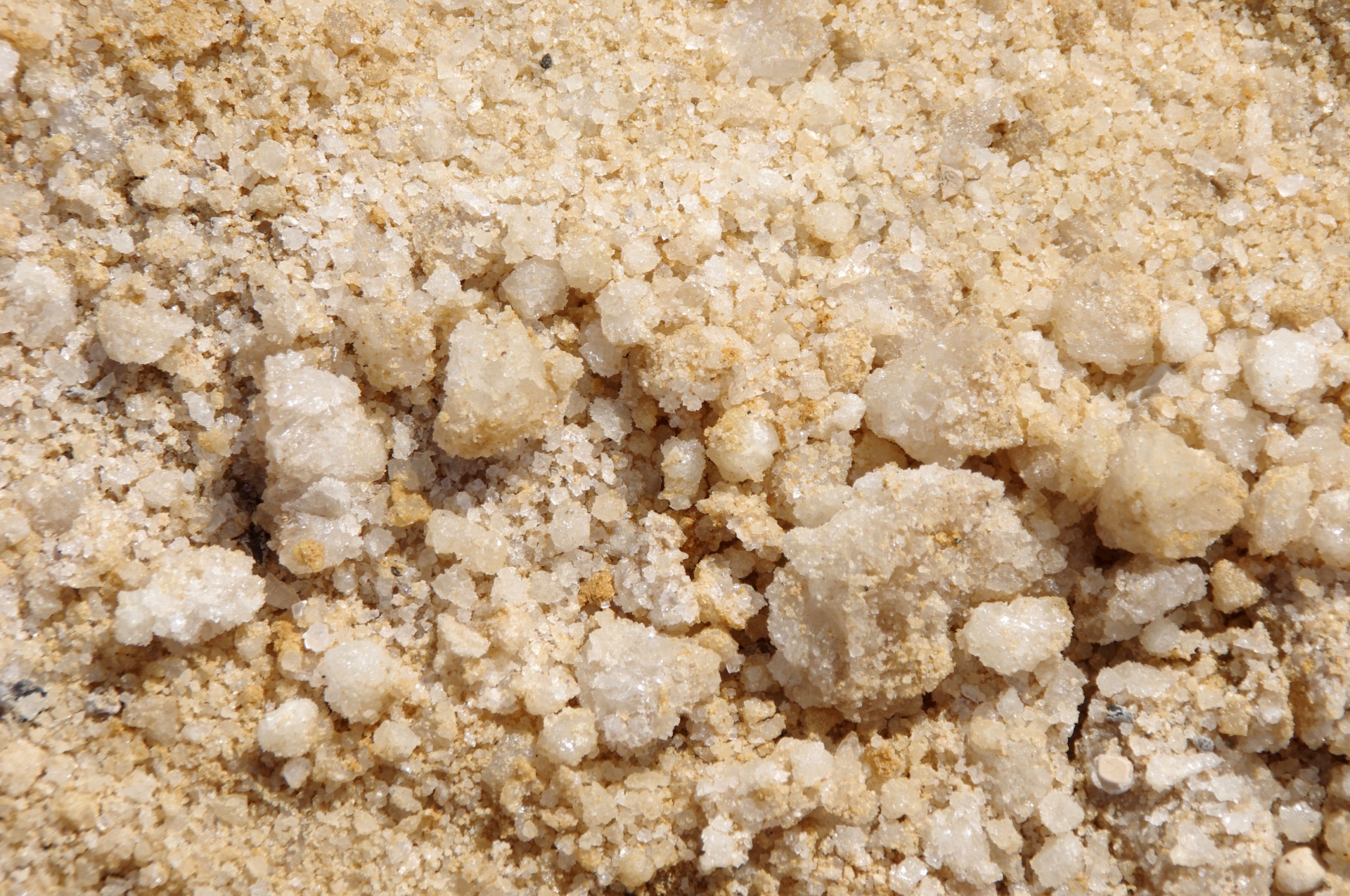
Halite bed
Primarily sodium chloride. Colour can arise from inclusions, lattice defects, iron oxides, organics, or dispersed clay—not from a standardized therapeutic mineral dose.
FUNCTIONAL CONSTANT · NaCl DOMINATES
Not one substance, but a family of ionic structures. Salt can be a geological archive, a culinary crystal, an osmotic regulator, a topical mineral bath, or the bond that makes a therapeutic molecule stable enough to use.
A salt forms when positively charged ions and negatively charged ions assemble into an electrically neutral compound. Sodium chloride is the familiar example, but magnesium sulfate, sodium bicarbonate, sodium citrate, thiamin hydrochloride, and disodium PQQ all belong to the wider chemical architecture.
The physiological effect follows the ions, dose, route, and matrix. Trace colour or origin does not automatically produce a clinically meaningful difference. Food salts remain principally sodium chloride unless a specification proves otherwise.
Compositionally unspecified commercial seasoning salts and highly processed novelty salts are excluded from functional profiles. Refined table salt may serve as a sodium-chloride reference, but not as a trace-mineral therapeutic matrix. Himalayan pink salt is intentionally excluded from every functional and active profile: colour, origin mythology, and trace-element marketing do not establish superior physiological action. It may be treated only as a culinary sodium-chloride product.
Classical Ayurvedic sources distinguish salts by origin, sensory character, inferred elemental quality, and thermal action. These are historical therapeutic descriptions—not modern clinical endorsements—and the identity of some preparations varies by text, region, and manufacturing method.
| Traditional name | Probable material | Elemental / sensory profile | Thermal character | Historical use |
|---|---|---|---|---|
| Saindhava lavaṇa | Rock salt / halite | NaCl-dominant; mild, less sharply saline; possible low-level Ca/Mg/K depending deposit | Traditionally cooling | Digestion, appetite, palatability, and as the preferred general salt |
| Sauvarchala | Black-salt family; processed mineral salt | NaCl with sulfurous volatile compounds; pungent aroma | Traditionally heating | Carminative use, digestive preparations, appetite |
| Vida / Bida | Processed alkaline salt; identity variable | May contain sodium salts plus alkaline/carbonized processing products | Traditionally heating and penetrating | Digestive mixtures and reduction of gas; formulation-specific |
| Samudra | Solar sea salt | NaCl-dominant with residual marine ions according to washing and crystallization | Usually described as heating | Food, preservation, and traditional digestive use |
| Romaka | Lake or saline-earth salt | Variable Na/Cl with carbonates, sulfates, and local earth-derived ions | Traditionally heating | Digestive and purgative contexts in historical texts |
| Audbhida | Earth-extracted / efflorescent salt | Alkaline and compositionally variable; may include carbonates and soil minerals | Traditionally heating, sharp | Specialized digestive and cleansing preparations |
Evidence boundary · “Cooling” and “heating” are properties within a traditional medical framework. They are not equivalent to measured body-temperature change.
Ancient salt beds form when enclosed seas or saline lakes evaporate. As water leaves, minerals precipitate in sequence: carbonates, gypsum or anhydrite, halite, then highly soluble potassium and magnesium salts. Burial, recrystallization, brine migration, clay seams, and fluid inclusions can alter the final matrix.
Primarily sodium chloride. Colour can arise from inclusions, lattice defects, iron oxides, organics, or dispersed clay—not from a standardized therapeutic mineral dose.
Late-stage evaporites can concentrate sylvite, carnallite, magnesium chlorides, and sulfates. Food use requires composition testing; “ancient” does not mean physiologically balanced.
Water dissolves a subterranean deposit and returns as brine. Its ion profile reflects the contacted strata, then changes again through clarification and crystallization.
Measured differences can be analytically real yet nutritionally trivial at normal salt intake. Deposits may also carry undesirable metals or other contaminants; identity and purity testing matter more than geological romance.
Dissolves readily and is widely used in warm baths. Warm water, buoyancy, and rest can reduce perceived stiffness and support relaxation. Claims of meaningful whole-body magnesium repletion through intact skin remain unproven.
Dead Sea salt mixtures are rich in magnesium and also contain potassium, calcium, bromide, and chloride in proportions unlike ordinary sea salt. Small controlled studies support local skin-barrier and hydration effects in specific contexts; this does not establish broad transdermal mineral therapy.
Relaxation after bathing is plausible and commonly reported, but the mechanism is not safely assigned to magnesium absorption alone. Heat increases tissue extensibility and circulation; immersion unloads joints; quiet rest changes autonomic tone. The bath is a system.
Do not use concentrated salts on broken skin without professional guidance. Oral magnesium sulfate is a laxative drug with contraindications; injectable magnesium sulfate belongs to clinical care.
Sodium and its accompanying anions are principal determinants of extracellular osmolality and volume. Potassium is concentrated inside cells. The sodium–potassium ATPase maintains these gradients, enabling membrane potential, nerve impulse transmission, nutrient transport, and muscle contraction.
Too little effective solute can impair fluid retention; too much extracellular sodium relative to water raises osmolality and stimulates thirst and hormonal water conservation. Hydration depends on water, sodium, potassium, losses, kidney function, and context.
Voltage-gated sodium entry depolarizes excitable membranes; potassium efflux helps repolarize them. Calcium, chloride, and magnesium further tune contraction and signalling.
The renin–angiotensin–aldosterone system, vasopressin, natriuretic peptides, and the kidneys continuously adjust sodium and water. Chronic excess can increase blood-pressure risk in susceptible populations.
Chloride, bicarbonate, and citrate deliver sodium with different taste, acid–base, and gastrointestinal characteristics. They are not interchangeable gram for gram; sodium yield and intended function must be calculated.
Fleur de sel is skimmed by hand from the fragile crystal film that develops at the surface of salt ponds under suitable wind and evaporation conditions. Its crystals retain interstitial brine and commonly carry several percent moisture. The open, irregular structure packs less densely than fine table salt, so a teaspoon can deliver less sodium by volume even when the dry crystal is still mostly NaCl.
Residual brine contributes measurable magnesium, calcium, and potassium traces and a slightly bitter-mineral finish. Those traces shape taste and texture more reliably than they change systemic nutrition.
Cold or warm smoke from applewood, hickory, peat, or other fuel deposits phenols, organic acids, carbonyls, and volatile aromatics on the crystal surface. Applewood tends to read sweet and light; hickory more assertive and bacon-like; peat adds earthy, medicinal, and tarry notes. Duration, temperature, airflow, humidity, particle size, and wood chemistry control uptake.
Smoke compounds can have antioxidant and antimicrobial activity in foods, but smoked salt is primarily a flavour carrier—not a validated stand-alone preservation system. Poor combustion can add polycyclic aromatic hydrocarbons; controlled smoke and contaminant specifications matter. “Smoke flavour” made with condensate is distinct from prolonged exposure to real wood smoke.
Active compounds with ionizable functional groups are often paired with a counter-ion. Salt selection can improve aqueous solubility, crystallinity, chemical stability, manufacturability, dissolution rate, shelf life, or delivery consistency. It does not guarantee better absorption: the optimal form depends on pKa, dose, route, hygroscopicity, polymorphism, excipients, and the intended dosage form.
Examples include thiamin hydrochloride, thiamin mononitrate, pyridoxine hydrochloride, calcium pantothenate, and sodium riboflavin phosphate. The counter-ion can make handling, stability, or dissolution more predictable; the vitamin’s biological identity is released or transformed after administration.
The disodium salt of pyrroloquinoline quinone is a stable, water-compatible supplemental form studied in cellular redox signalling. Preclinical work links PQQ signalling to PGC-1α and mitochondrial biogenesis. A small human study observed a related biomarker change but no clear exercise-performance benefit.
Three sodium salts can distribute the same cation across three functional anions. The design question is not “which sodium is best?” It is how much elemental sodium the system yields, which anions accompany it, and what the user must tolerate.
The foundational osmotic regulator. Sodium helps set extracellular volume; chloride maintains electroneutrality, contributes to gastric acid, and travels through multiple transport systems. High chloride loads can taste aggressive and may be harder to tolerate in concentrated drinks.
An extracellular acid–base buffer. In high-intensity exercise, an increased bicarbonate reserve can improve the gradient for movement of hydrogen ions out of working muscle. Effective performance doses are specialized and commonly cause belching, nausea, cramping, or diarrhea.
Readily absorbed and metabolized, with citrate entering normal intermediary metabolism and generating an alkalinizing effect. It supplies sodium without adding chloride, offers a softer saline profile, and can reduce reliance on an aggressive all-chloride load. That may improve drink tolerance, but large doses can still cause gastrointestinal distress; “gentler” remains formulation-dependent.
Krebs-cycle precision · citrate is a cycle intermediate, but swallowing sodium citrate does not make it a direct mitochondrial fuel or guarantee more cellular energy. Its best-established formulation roles are counter-ion, buffering/alkalinizing capacity, and taste architecture.
ELECTROLYFE uses sodium chloride, sodium bicarbonate, and sodium citrate as its sodium architecture. The Codex establishes the chemistry behind that selection while keeping formulation claims inside a strict evidence boundary.
Specification boundary · Each salt contributes a different fraction of elemental sodium. Hydrate state and final label yield require calculation against the production specification; compound weights are not interchangeable with elemental sodium.
Primary, regulatory, and review sources define what can be stated as established, limited, contextual, or historical. Traditional use is documented as cultural history; mechanistic plausibility is not presented as clinical proof.
Sodium and potassium manipulation can be unsafe in kidney, heart, endocrine, or blood-pressure disorders and with certain medicines. Sodium bicarbonate and citrate are not casual high-dose wellness ingredients. This reference is informational and does not replace individualized medical advice.
This reference is educational, not medical advice. Traditional claims are identified as historical descriptions. Product and physiological statements require route-, dose-, and population-specific interpretation. Consult a qualified healthcare professional before using concentrated mineral salts or changing electrolyte intake.