↳ You followed a term. This is the full Codex entry behind the hover gloss for “anupana.”
The Codex  /  Terms  /  Anupana
Term · Ayurvedic pharmacology

Anupana

Sanskrit anu-pāna, “that which is drunk after” · /ə‑nuːˈpɑː‑nə/ · a carrier · a vehicle · an adjuvant

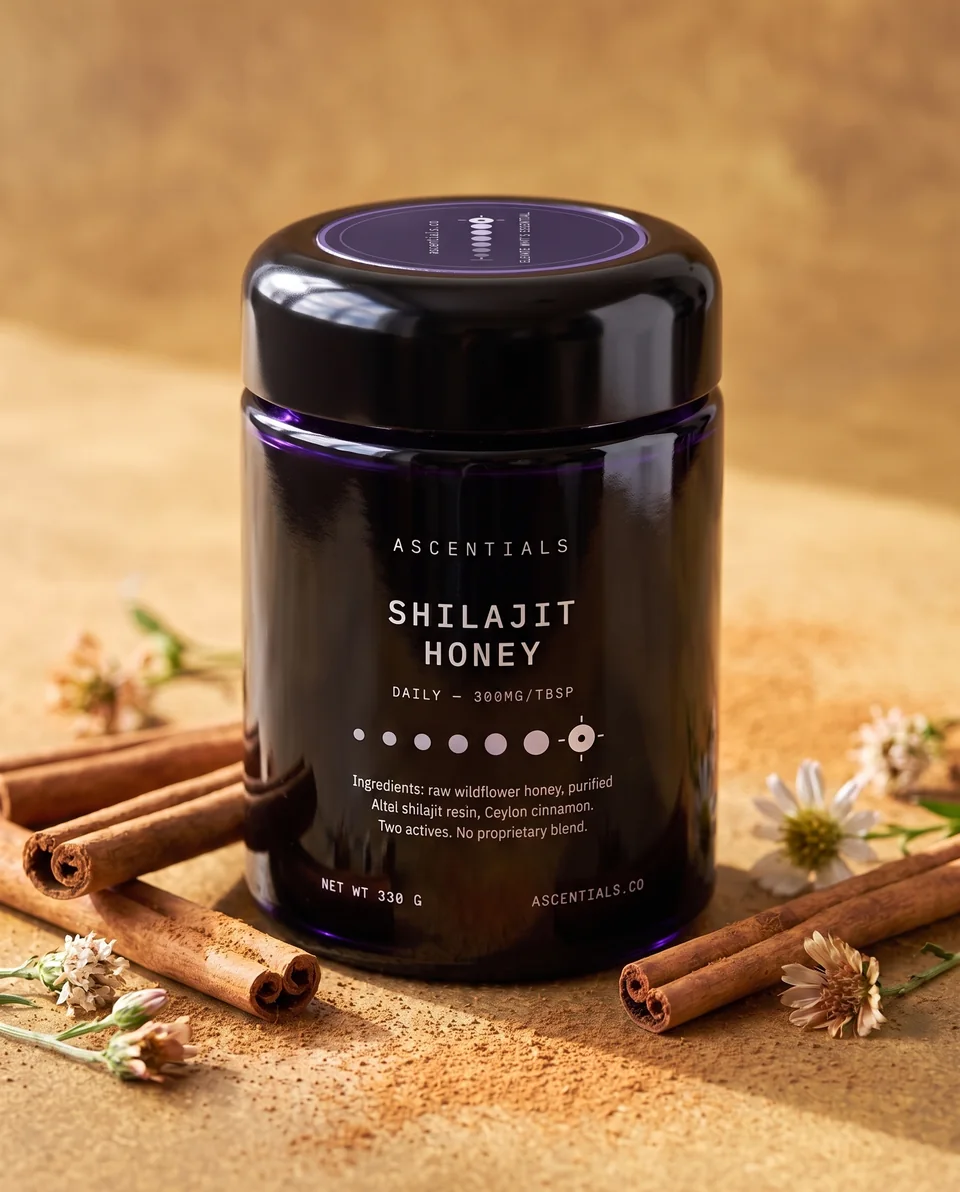
A carrier substance in Ayurvedic pharmacology that drives active compounds deeper into tissue — turning what could be a passive vehicle into a delivery technology. In ASCENTIALS, the anupana is the reason the honey line exists.

01 · Definition

What it is

Anupana (Sanskrit anu-pāna, “that which is drunk after”) is the substance an active compound is delivered in — the vehicle, not the payload. In classical Ayurveda it is not treated as passive garnish: the vehicle is chosen deliberately for what it does to the compound's absorption, its distribution in the body, and the tissues (dhātus) it reaches. Honey, ghee, warm milk, hot water, and rice broth are the canonical anupanas — each matched to a different clinical intent. Change the anupana and you change the medicine.

The Chinese materia medica formalizes the same principle as mi zhi — “honey-fried herbs” — a preparation method standard across the tradition. Modern pharmacology names the same idea drug delivery. The vocabulary is different; the observation is the same: the vehicle is not neutral.

02 · Mechanism

How it works

Three mechanisms carry the concept from tradition into modern legibility.

First, enzymatic protection. Honey's proteinaceous matrix and low water activity shield delicate phytochemicals from stomach acid and digestive enzymes, buying them time to be absorbed further down the tract. This is why honey-vehicled preparations often outperform the same botanicals delivered in water — and why heat is the enemy: above roughly 40°C, the enzymes begin to denature and the anupana loses its function.

Second, membrane permeability. Certain anupanas — honey, ghee, warm milk — alter the physical state of the intestinal membrane briefly, widening the absorption window. In the ASCENTIALS honey line, fulvic acid does complementary work at the cellular level, extending the same logic from the gut wall to the mitochondrion.

Third, tissue targeting. Classical Ayurveda prescribes different anupanas to steer a compound toward different dhātus — warm water to digestion, milk to the reproductive tissues, ghee to the nervous system. Modern pharmacokinetics has begun mapping the same phenomenon under the heading of vehicle-dependent biodistribution.

03 · Key facts

At a glance

1,500+ yrsDocumented in classical Ayurveda
4Canonical vehicles · honey · ghee · milk · water
< 40°COur honey-infusion ceiling
2Traditions that formalize the concept
04 · References

Where the concept lives

For a traditional principle the evidence layer is a lineage rather than a trial stack: the classical text that defines it, the modern review that translates it, and the clinical work that measures its modern parallel. Each line links to the full record in The Archive.

01
Charaka Saṃhitā · Sūtrasthāna Classical
Classical description of anupana as the vehicle that determines a compound's tissue reach — c. 2nd century BCE compilation.
Archive →
02
Ali A, et al. · J Ethnopharmacol. · 2018 Review
Reviews the anupana concept and its modern pharmacokinetic parallels in phytomedicine.
Archive →
03
Mandal MD, Mandal S · Asian Pac J Trop Biomed · 2011 Preclinical
Honey as a delivery vehicle — enzymatic matrix and bioactive preservation under thermal limits.
Archive →
05 · In our formulas

Where you'll find it

The ASCENTIALS honey line is anupana in practice. Every batch is infused below the enzyme-denaturation threshold so the vehicle stays active — the payload is the botanicals; the honey is what gets them where they're going.

07 · Related reading

Go deeper

These statements have not been evaluated by the Food and Drug Administration. This product is not intended to diagnose, treat, cure, or prevent any disease. Codex entries describe structure-function mechanisms and cite published literature and classical texts; they are informational and not medical advice. Effect timelines are stated honestly — many are gradual.

Entry CDX·003 Category Term Reviewed Jul 2026 The Codex · ASCENTIALS