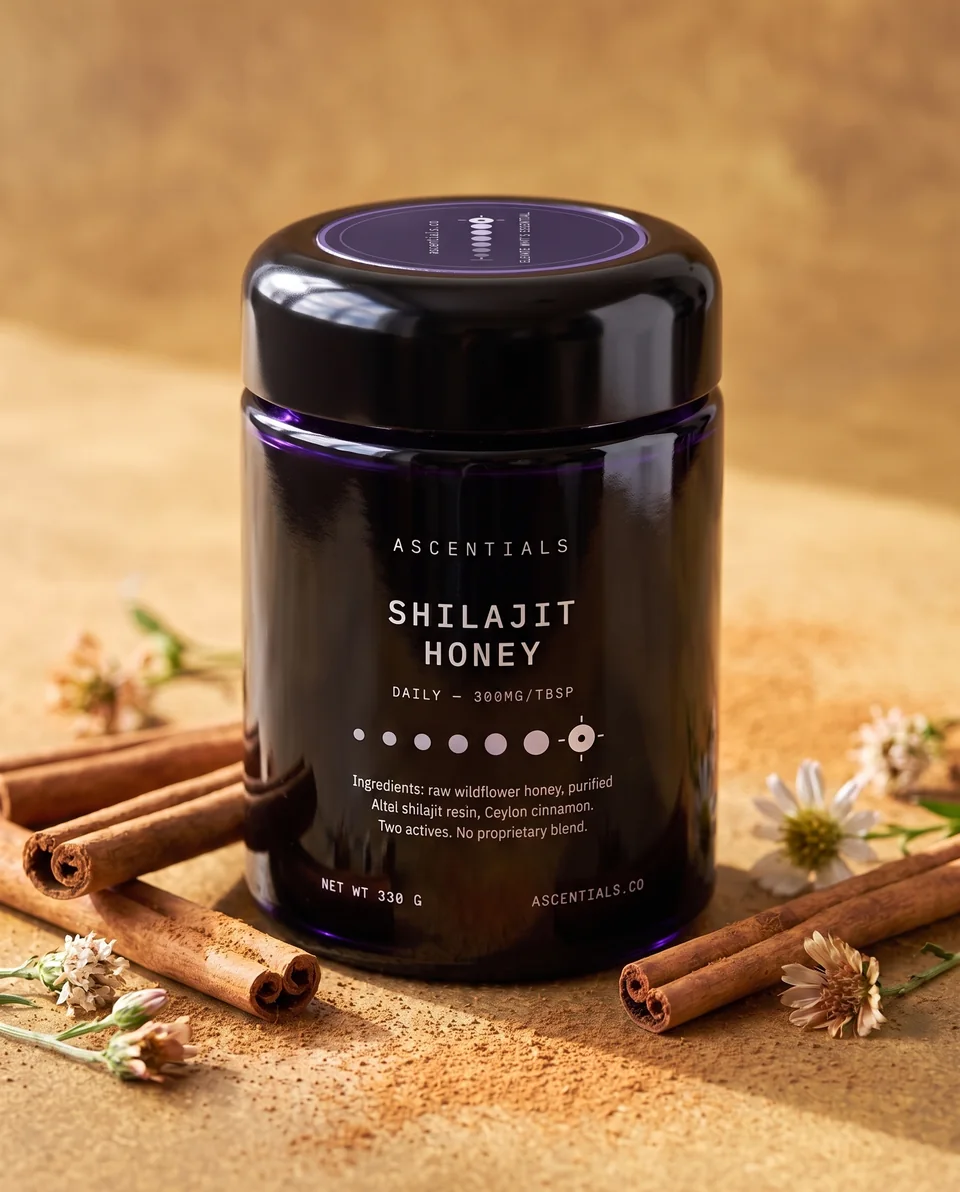
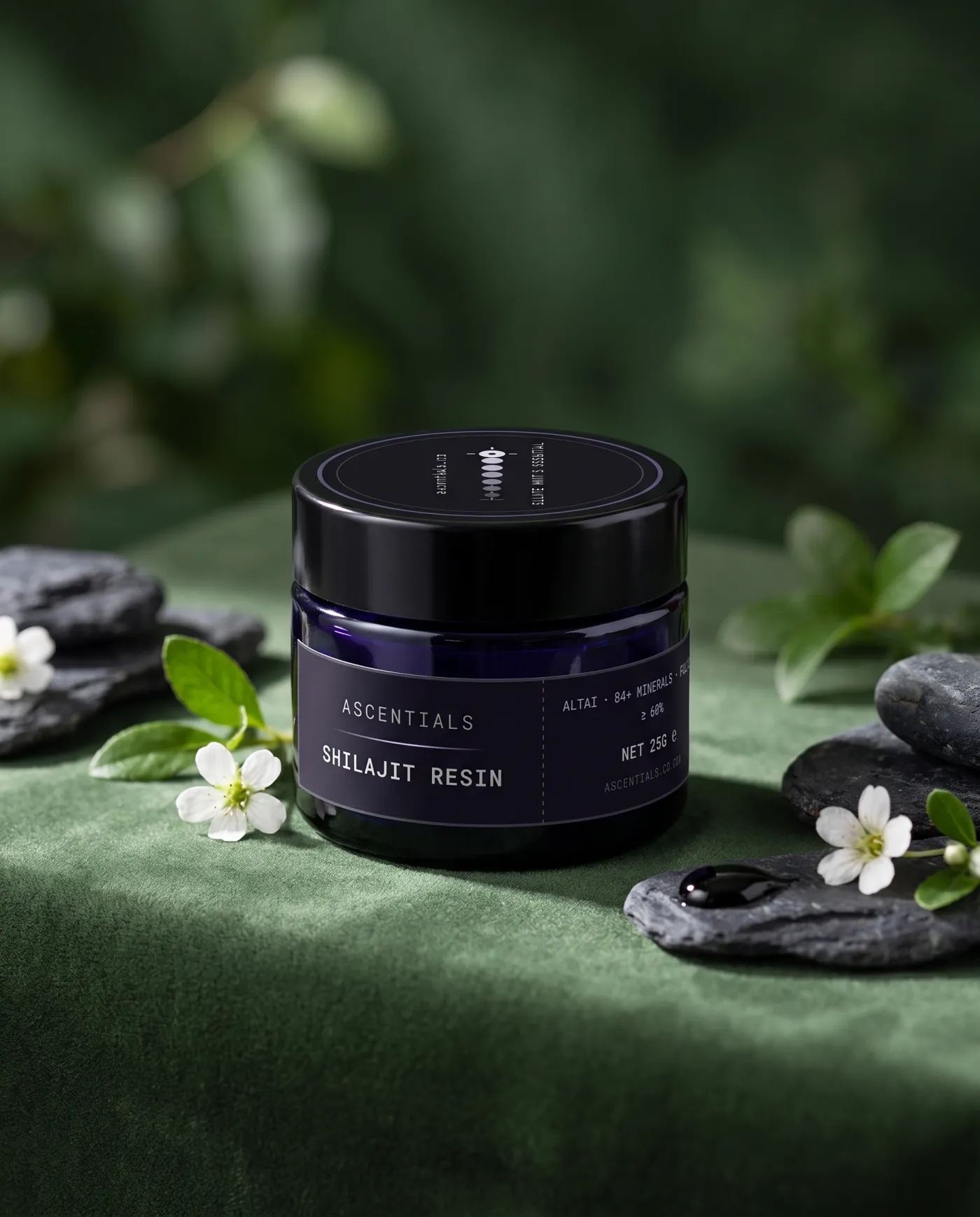
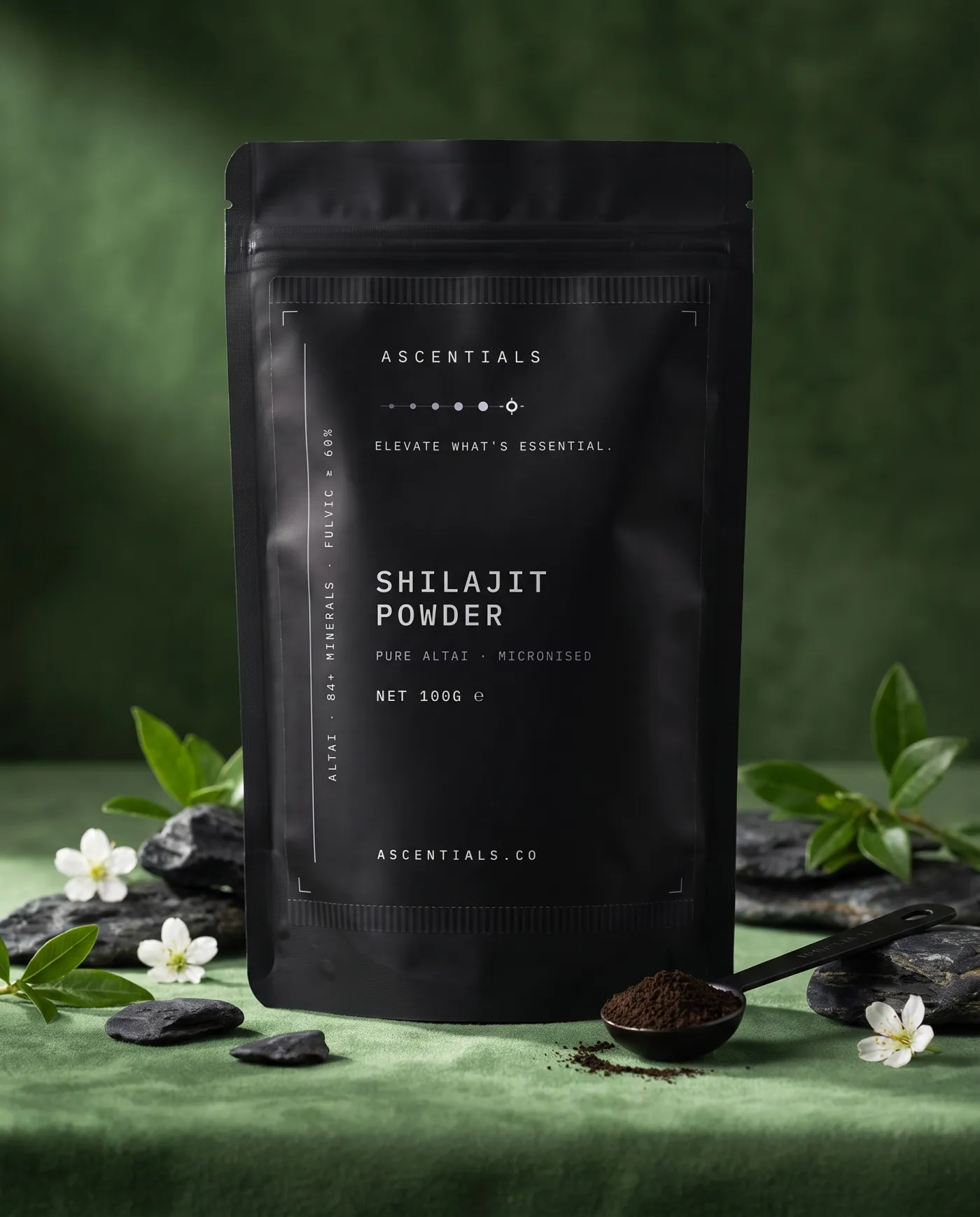
↳ You followed a term. This is the full Codex entry behind the hover gloss for “shilajit.”
The Codex  /  Ingredients  /  Shilajit
Ingredient · Humic exudate

Shilajit

/ˈʃiːlədʒiːt/ · a humic exudate · the Altai resin · syn. mumijo

The mineral-rich resin that seeps from high-altitude rock — a humic exudate whose activity concentrates in its fulvic acid and dibenzo-α-pyrone fractions. In ASCENTIALS, it is standardized by fulvic percentage and assayed for purity, not sold by the length of its mineral list.

01 · Definition

What it is

Shilajit is not a plant, a mineral, or a fungus — it is a humic exudate: the slow product of plant and microbial matter compressed into rock over centuries, seeping from cracks at altitude as a blackish-brown resin. Chemically it belongs to the humic substances, carrying fulvic and humic acids, aromatic small molecules, and trace minerals.

ASCENTIALS sources from the Altai range above 3,000 metres, cold-extracted to protect the active fractions. Quality is defined the honest way: by standardized fulvic percentage and a clean contaminant assay — not by how many minerals a label can list.

02 · Mechanism

How it works

Shilajit's activity is really the activity of its fractions. The lead actor is fulvic acid: small and oxygen-rich, it binds mineral ions through chelation, ferries them across the intestinal wall, and both donates and accepts electrons to buffer oxidative stress.

Travelling with it, the dibenzo-α-pyrones are studied as electron carriers in mitochondrial energy transfer. The review literature names these two — fulvic acid and the dibenzo-α-pyrones — as the constituents most responsible for shilajit's reported effects. The mineral content matters mainly as cargo.

03 · Key facts

At a glance

≥60%Standardized fulvic
>3,000 mAltai source altitude
250–500 mgStudied daily dose
~90 daysEndocrine effect window
04 · Evidence

What the literature shows

A condensed view. Each line links to the full review in The Archive, where the complete methods, limitations, and citations live. The human evidence is small but real; the broader base is preclinical and review-level.

01
Pandit S, et al. · Andrologia · 2016 RCT
250 mg ×2/day, 90 days, men 45–55 — significant rise in total/free testosterone & DHEAS vs. placebo; LH/FSH maintained.
Archive →
02
Keller JL, et al. · J Int Soc Sports Nutr · 2019 RCT
500 mg/day, 8 weeks — decreased serum hydroxyproline (collagen breakdown) and retained maximal strength after fatigue.
Archive →
03
Stohs SJ · Phytother Res · 2014 Review
Safety/efficacy review — adaptogenic, antioxidant, anti-inflammatory signals; notes purified shilajit's acceptable heavy-metal profile.
Archive →
05 · In our formulas

Where you'll find it

07 · Related reading

Go deeper

These statements have not been evaluated by the Food and Drug Administration. This product is not intended to diagnose, treat, cure, or prevent any disease. Codex entries describe structure-function mechanisms and cite published literature; they are informational and not medical advice. Effect timelines are stated honestly — many are gradual.

Entry CDX·016 Category Ingredient Reviewed Jul 2026 The Codex · ASCENTIALS