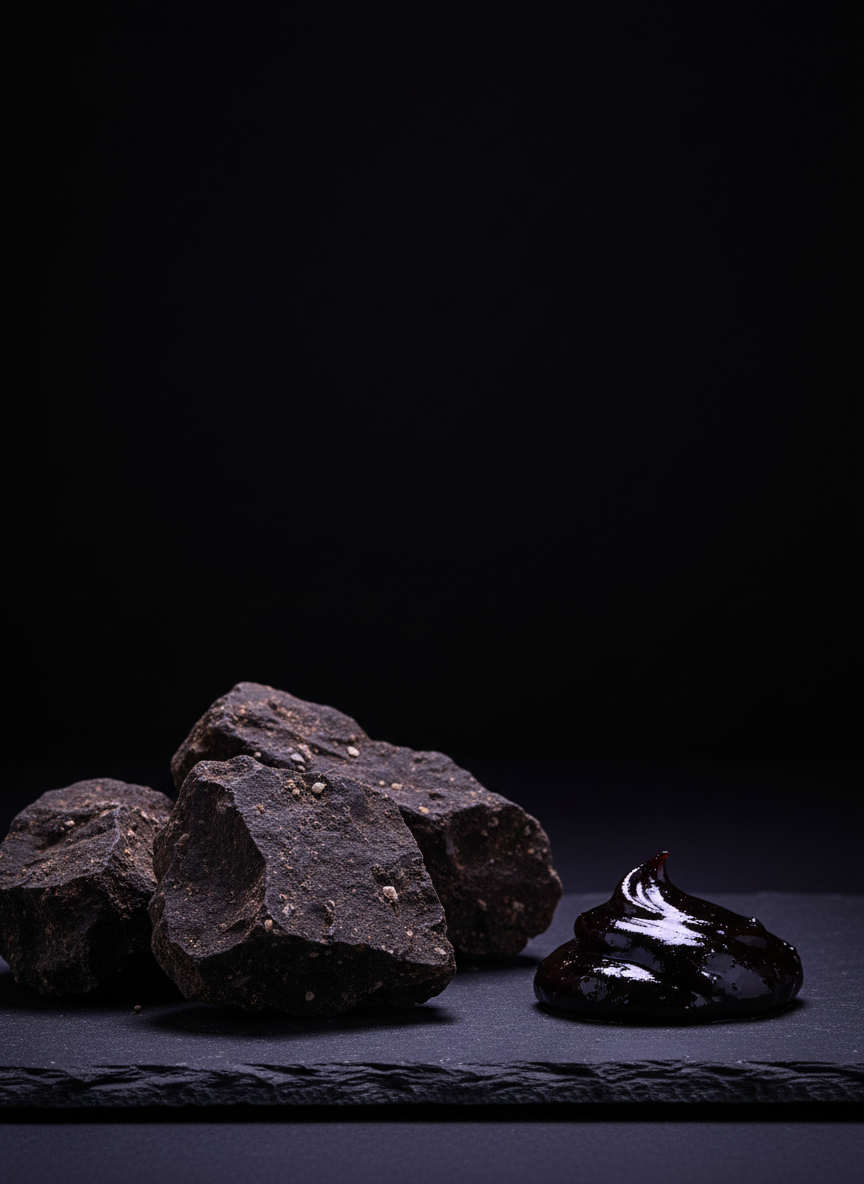
Somewhere above three thousand metres, in the cold of the Altai, a dark resin weeps out of the rock. It is not a plant and not a mineral. It is what is left when plant matter and microbes are pressed into stone for centuries — a concentrate the mountain made slowly, and the internet discovered quickly.
That last part is the problem. A substance that took the geology a few centuries to assemble is now sold on the strength of a screenshot: 85+ minerals, the labels say, as if a longer list were a better one. It isn't. The interesting thing about shilajit was never the length of its mineral roster. It's a much smaller story, and a more honest one.
The part that does the work
Strip a good resin down and the activity concentrates in a narrow fraction. The lead actor is fulvic acid — a family of small, oxygen-rich organic acids light enough to cross a cell membrane and reactive enough to carry other molecules across with them. Travelling alongside it are the dibenzo-α-pyrones, aromatic little passengers studied as electron carriers in cellular energy transfer.
The minerals matter, but mostly as cargo. What makes shilajit worth talking about is bioavailability — the delivery, not the payload. Which is why the number that belongs on the label isn't the count of minerals. It's the standardized fulvic percentage, and the assay that proves it.
The interesting thing was never the eighty-five minerals. It was the one fraction small enough to get them where they're going.
Milligrams over mysticism
We are a brand that likes the old story — the mountain, the ritual, the five thousand years. But we hold it to a modern standard. So here is the honest version of the evidence, the same one written up in full in the Archive review.
Two small randomized trials anchor the human case. In one, purified shilajit at 250 mg twice a day raised total and free testosterone in healthy men aged 45–55 — measured over ninety days, not overnight. In another, 500 mg a day helped active men retain strength after fatiguing exercise and lowered a marker of collagen breakdown over eight weeks. Around that sits a broader base of reviews and animal work on energy and mitochondria — promising, mechanistic, and clearly labelled as not-yet-proven-in-people.
Notice what that paragraph doesn't do. It doesn't promise a cure, and it doesn't pretend the effect is instant. Shilajit is a gradual agent. An expectation set on a ninety-day curve is honest; one set on a single dose is marketing.
Why purity is the product
Here is the part most of the moment skips. Because shilajit forms in rock, raw resin can carry exactly what you'd fear from rock — lead, arsenic, mercury, aluminium — plus, if it's badly handled, mould and mycotoxins. Its origin is its liability.
The resolution is boring and non-negotiable: proper purification, and a per-batch Certificate of Analysis that screens for heavy metals by mass spectrometry. When we say our Altai resin is standardized to ≥60% fulvic acid and third-party assayed, that isn't a premium tier. It's the precondition for every effect above being worth anything at all. The same chemistry that lets fulvic acid escort minerals in — chelation — is why the contamination test can't be optional.
What to actually look for
If you take one thing from this note: ignore the mineral count. Ask three questions instead. What's the standardized fulvic percentage? Is there a Certificate of Analysis you can actually read? And does the brand state its effect timelines honestly, or imply something happens on day one? A resin that answers all three is doing the real work the mountain started.
The oldest medicine, in other words — held to the next frontier's standard.